
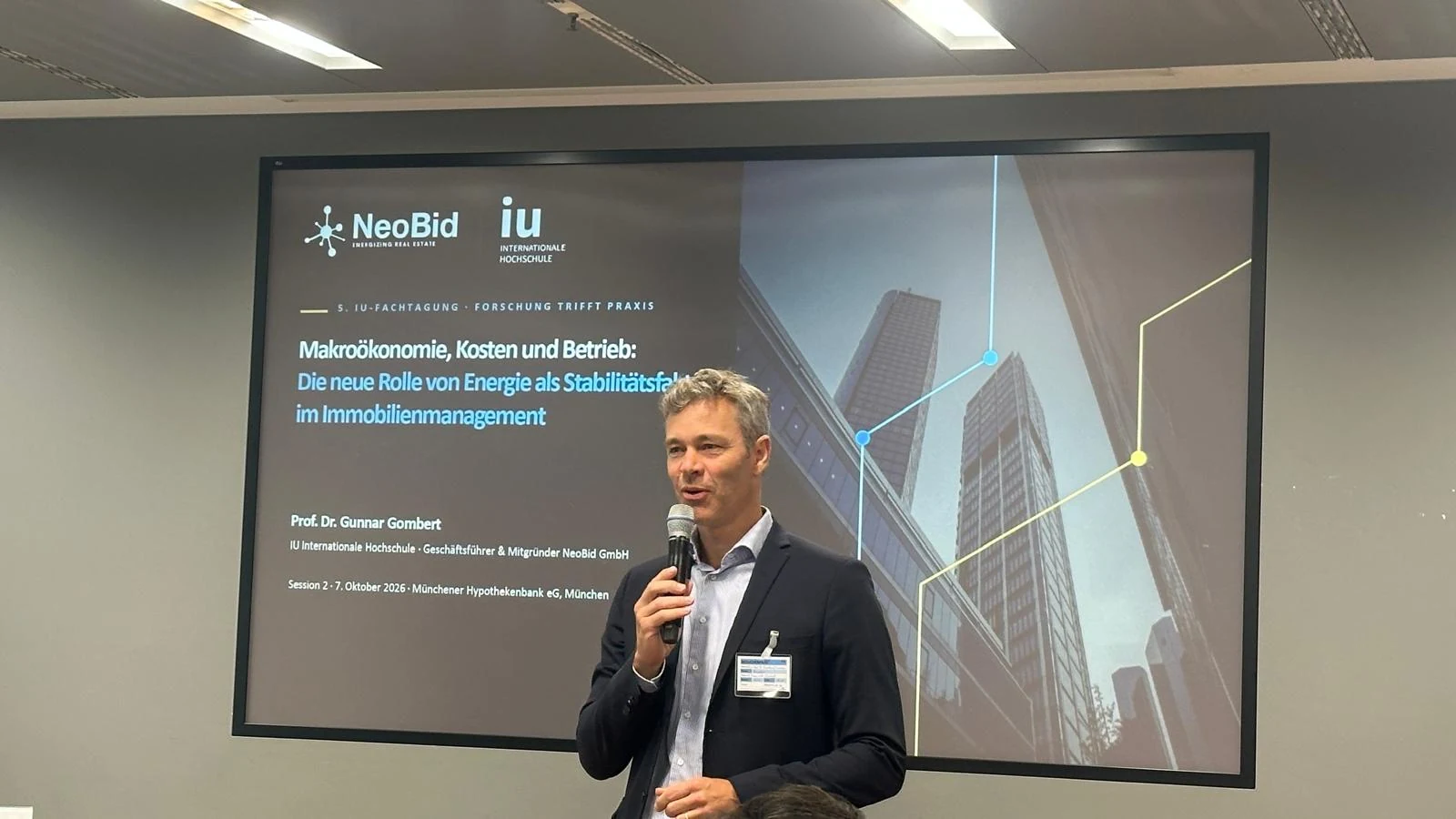
On 7 October 2026, the final day of EXPO REAL, the 5th IU Conference “Research Meets Practice” brought academia and the real estate sector together at Münchener Hypothekenbank in Munich. In Session 2, Professor Gunnar Gombert of IU International University of Applied Sciences, Managing Director and Co-Founder of NeoBid, explored the changing role of energy in real estate management.
Energy as a stabilising factor: key takeaways
- Energy becomes more manageable when markets, procurement strategy, contracts, data and building operations are assessed together.
- Price fixing limits the effect of a price shock on secured volumes, but it does not guarantee a lower average price.
- Reliable portfolio data reveals the exposure carried by owners and occupiers and where action can have the greatest commercial impact.
Stability does not happen automatically
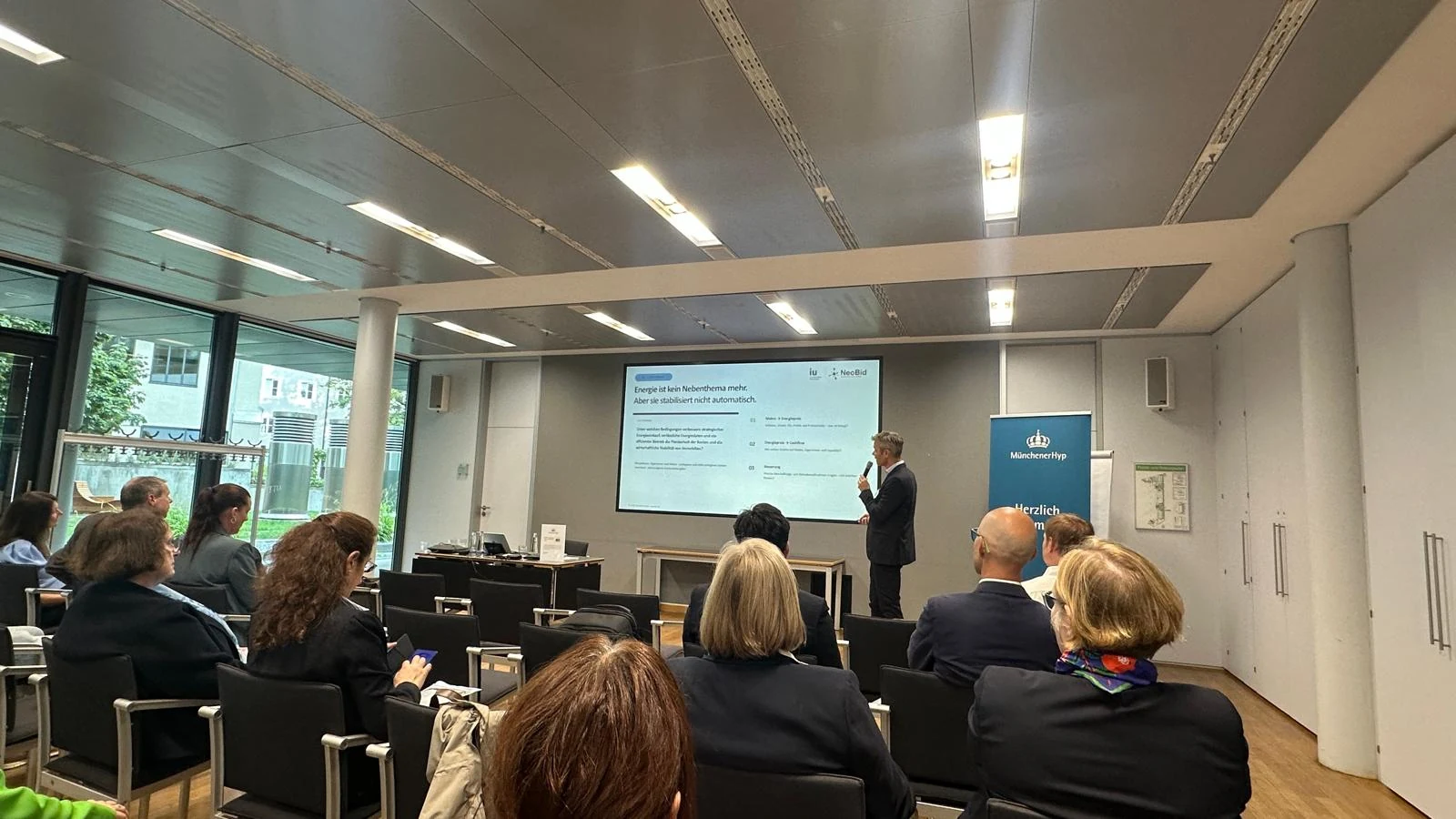
Energy remains a dynamic cost item. A fixed price, early procurement or a consumption forecast does not by itself make energy a stabilising factor. Stability emerges when procurement strategy, data, contract design and building operations work together.
The objective is not to eliminate every market movement or identify the lowest point. It is to make price, volume and timing risks transparent, establish decision rules and align supply with the commercial needs of the portfolio. A structured procurement strategy spreads risk across models and purchasing dates, but it cannot promise a systematically lower average price.
Why the same price movement affects owners and occupiers differently
Rising energy prices do not have the same effect everywhere. In leased assets, occupiers bear much of the recoverable cost. Depending on the contract and asset, the owner may still carry vacancy-related energy costs, non-recoverable components, pre-financing, carbon-cost shares and indirect effects on lettability or cash flow.
The key question is therefore not simply: “Where is the market price going?” It is: Which price and volume risks affect whom, when and by how much? Answering it requires a consistent view of supply points, contracts, consumption data and responsibilities. This is where structured energy data becomes a prerequisite for commercial decisions.
What a simplified example reveals
The presentation used a deliberately simplified office building: 10,000 square metres of lettable area, ten per cent vacancy, annual electricity consumption of 1,000 MWh and annual gas consumption of 1,200 MWh. With the full energy volume exposed and prices rising by 50 per cent, the modelled annual burden increases by €164,250 for occupiers and by €18,250 for the owner because of vacancy. Energy's share of the modelled occupier burden rises from 13.2 to 18.6 per cent.
If 70 per cent of the volume has already been fixed at earlier conditions, the same shock affects only the open balance. The modelled increase falls to €49,275 for occupiers and €5,475 for the owner. A ten per cent reduction in consumption would lower the baseline burden by €32,850 for occupiers and €3,650 for the owner.
Important: These figures illustrate sensitivities. They are neither a forecast nor a real asset case. The model assumes, among other things, full contractual recovery of energy costs across occupied space; other service charges and the specific allocation of carbon costs are outside its scope.
Four elements of manageable energy risk
- Procurement strategy: open volumes, price fixing, contract terms and risk appetite are aligned deliberately. Tranche procurement can spread timing risk without promising a cheaper outcome.
- Reliable data: supply points, consumption, load profiles, floor areas and contract dates need to be comparable and plausible.
- Contracts and competition: a clear specification makes bids comparable. Volume bands, tolerances, price components, security requirements and guarantees of origin belong in the assessment.
- Operations and consumption: every kilowatt-hour avoided on a lasting basis reduces the volume that needs to be procured. Technical efficiency and commercial procurement reinforce one another.
Five questions for portfolio management
- Which energy volumes are already fixed for future delivery years, and which remain open?
- Where do vacancy, non-recoverable components or pre-financing create owner exposure?
- Are consumption and contract data complete and plausible for each asset?
- Which procurement models fit the portfolio's risk appetite and decision processes?
- How will deviations and responsibilities be managed after contract award?
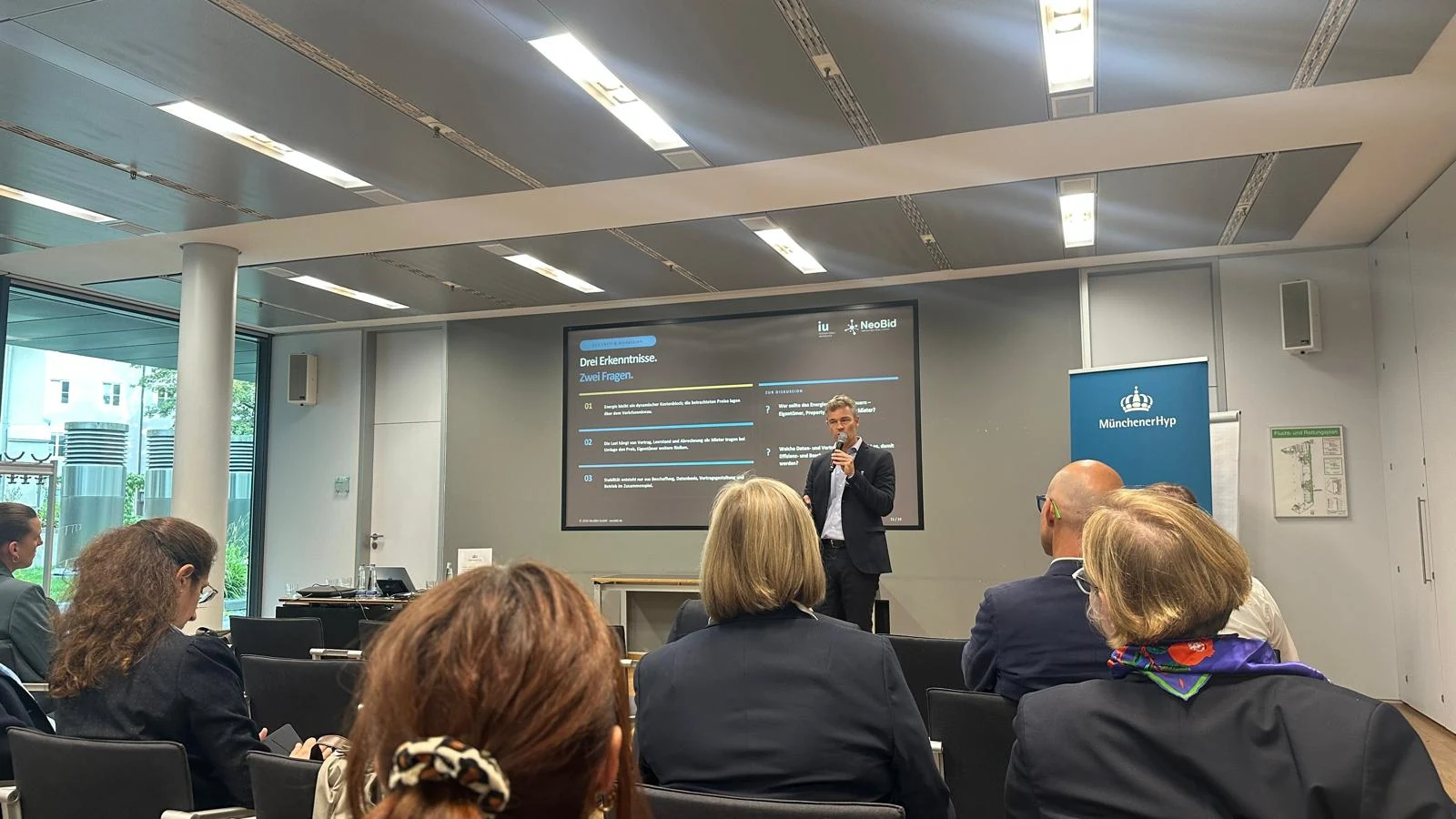
The central conclusion from the discussion was clear: energy becomes a stabilising factor when markets, contracts, data and operations are managed together. An isolated price comparison is insufficient. Only the portfolio view reveals which risks remain open and where action is likely to have the greatest commercial effect.
Put portfolio energy risk into context
NeoBid connects procurement strategy, competitive tendering, energy data and support throughout the contract term. In an introductory meeting, we identify the volumes, dates and data that matter first for your portfolio.