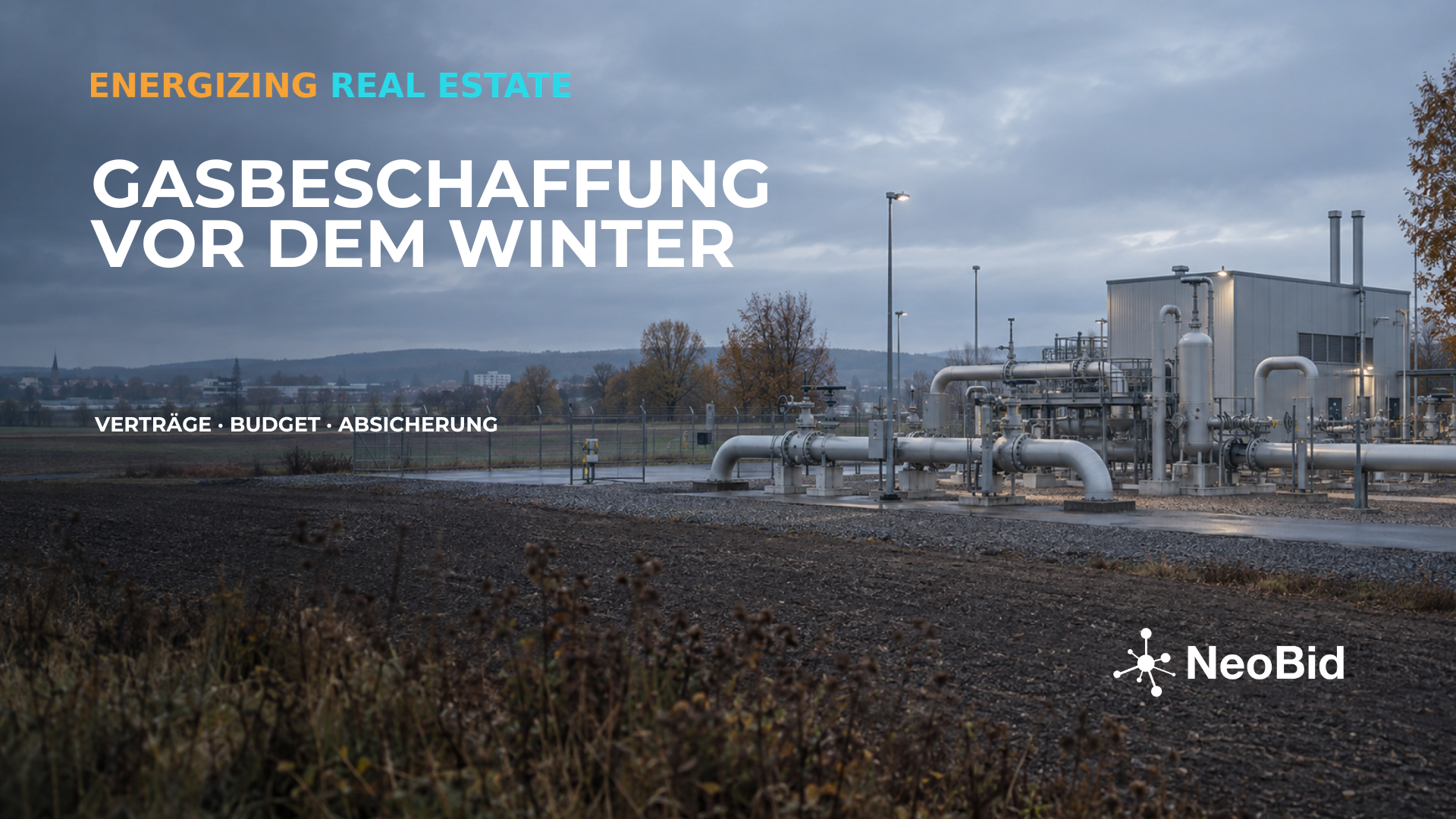
The German government plans additional incentives to keep more gas available for winter. For property owners and managers, this raises a practical question: how well is the portfolio's gas demand for the coming heating season already secured?
The answer mainly depends on existing supply contracts, price fixing and volumes still open. The policy initiative is a reason to review this position. It does not yet provide a clear forecast of rising or falling gas prices.
What is changing in the market
According to reporting on 16 September, a planned tender for long-term gas options is to be expanded. The additional volume remains open. SEFE has also confirmed that it is buying gas for storage. The measures aim to strengthen available reserves for winter. Tagesschau, 16 September 2026, Handelsblatt, 16 September 2026
From a procurement perspective, these measures can have opposing effects: additional purchases initially increase demand. Higher stocks may later reduce the risk of shortages and winter price spikes. Without specific volumes and tender conditions, it remains unclear which effect will prevail.
The key is how well your own portfolio is secured
Three contractual situations should be distinguished:
Starting position | Implications for procurement |
The supply contract and energy price are fixed for the heating season | The news does not immediately change the agreed energy price. Volume provisions and the subsequent delivery period remain particularly relevant. |
Supply is agreed, but the price is wholly or partly indexed | Market movements may affect costs according to the price formula. Assess how much of the budget remains exposed to price fluctuations. |
A follow-on contract or individual procurement tranches are still missing | Decisions are still needed for these volumes. Current offers should be assessed against budgets, deadlines and the accepted level of price uncertainty. |
An active supply contract therefore does not automatically mean that energy costs are fixed. Conversely, concerning market news does not create additional procurement needs for volumes already secured.
Quantify budget risks
Calculating the impact of possible price changes on open volumes helps decision-making.
A simplified example: if the price of two million kilowatt-hours of gas is still open for an upcoming delivery period, a change of one cent per kilowatt-hour in the procurement price means a cost difference of €20,000. This is a sensitivity calculation, not a price forecast.
This assessment shows how much market movement the portfolio can absorb. It helps determine whether fully fixing the price, buying in stages or deliberately leaving a portion open fits the budget objectives. Available models and terms must be checked against actual supply offers.
Volumes and contractual terms are part of the decision
Expected consumption deserves attention alongside price. A colder winter, changes in occupancy or a delayed heating conversion can increase gas demand above plan. How the supply contract treats excess and shortfall volumes then becomes crucial.
Comparing offers should therefore consider price fixing, volume flexibility and settlement of deviations together. A low initial price may carry additional risks if actual consumption differs significantly from the agreed volume.
How NeoBid supports you
NeoBid brings together consumption, cost and contract data for supply points to establish the basis for procurement decisions: which volumes are already secured? Where does price fixing end? Which supply points need a follow-on contract?
On this basis, NeoBid develops a procurement strategy with the client, obtains comparable supply offers and assesses price, duration and volume terms together. The decision reflects the portfolio's specific circumstances and available market offers.
The planned storage incentives therefore provide a useful prompt for review. For each property business, the value comes from understanding its own position and agreeing how to manage the remaining risks.
Further reading: data foundation for an energy tender and Decision rules for energy procurement.
As at 16 September 2026