
According to Next Kraftwerke, the share of renewables in German electricity generation reached its highest level of the year so far in July 2026. At the same time, electricity for delivery in 2027 became more expensive. The merit order helps explain this relationship. For property portfolios, consumption profiles, gas price developments and procurement strategy should be considered together.
How the merit order forms electricity prices
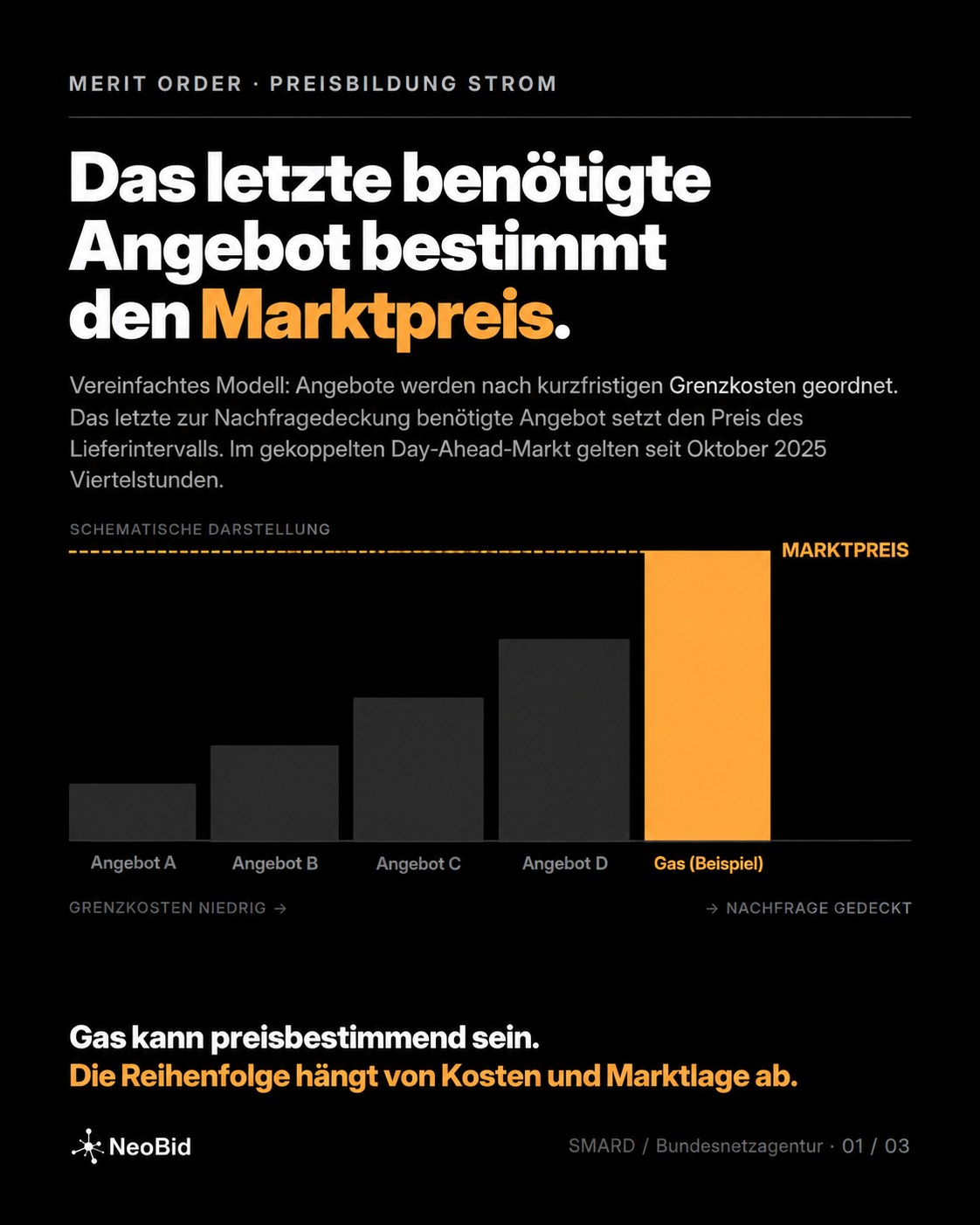
In simplified terms, the merit order ranks generation offers by their short-run marginal costs. Wind and solar power typically come first because they have no fuel costs. If this generation is insufficient, further offers are needed. The last offer required determines the uniform market price for that delivery interval. A gas-fired plant may set the price, but this is not the case in every interval. Since 1 October 2025, the coupled day-ahead market has traded in quarter-hour intervals.
Why high renewable generation does not automatically mean low forward prices
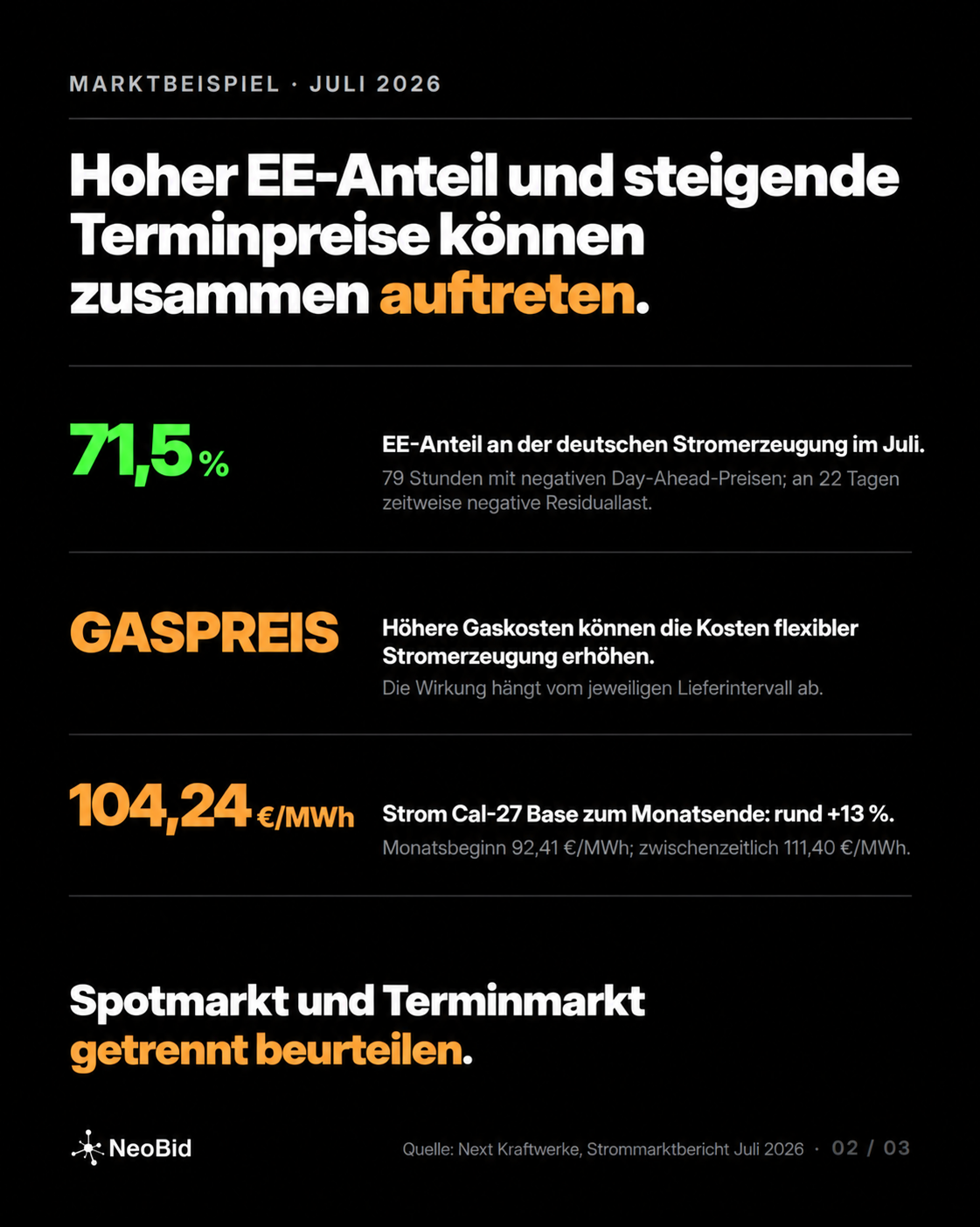
In July 2026, renewables accounted for 71.5 per cent of German electricity generation. There were also 79 hours with negative day-ahead prices and periods of negative residual load on 22 days. This development mainly affects the short-term spot market and often the midday hours.
The forward market, by contrast, prices expected costs and risks for a future delivery period. The front year 2027 rose in July from €92.41/MWh to a peak of €111.40/MWh and closed the month at €104.24/MWh — an increase of around 13 per cent. Gas prices also rose significantly. The charts provide context for historical market values from July and August 2026.
What this means for property portfolios
Properties do not consume electricity only during inexpensive solar hours. Offices, retail properties, hotels, logistics assets and residential portfolios have different load profiles. Evening consumption, baseload and seasonal peaks may therefore coincide with periods when flexible, more expensive plants set the price.
The contracting date influences the price level, but without a market comparison it is only a single snapshot.
Load profile and supply structure determine how strongly spot and forward market movements affect an offer.
Individual offers can only be compared reliably using identical volume, duration and risk requirements.
Complete supply point, contract and consumption data are prerequisites for real competition.
Assess spot and forward markets separately
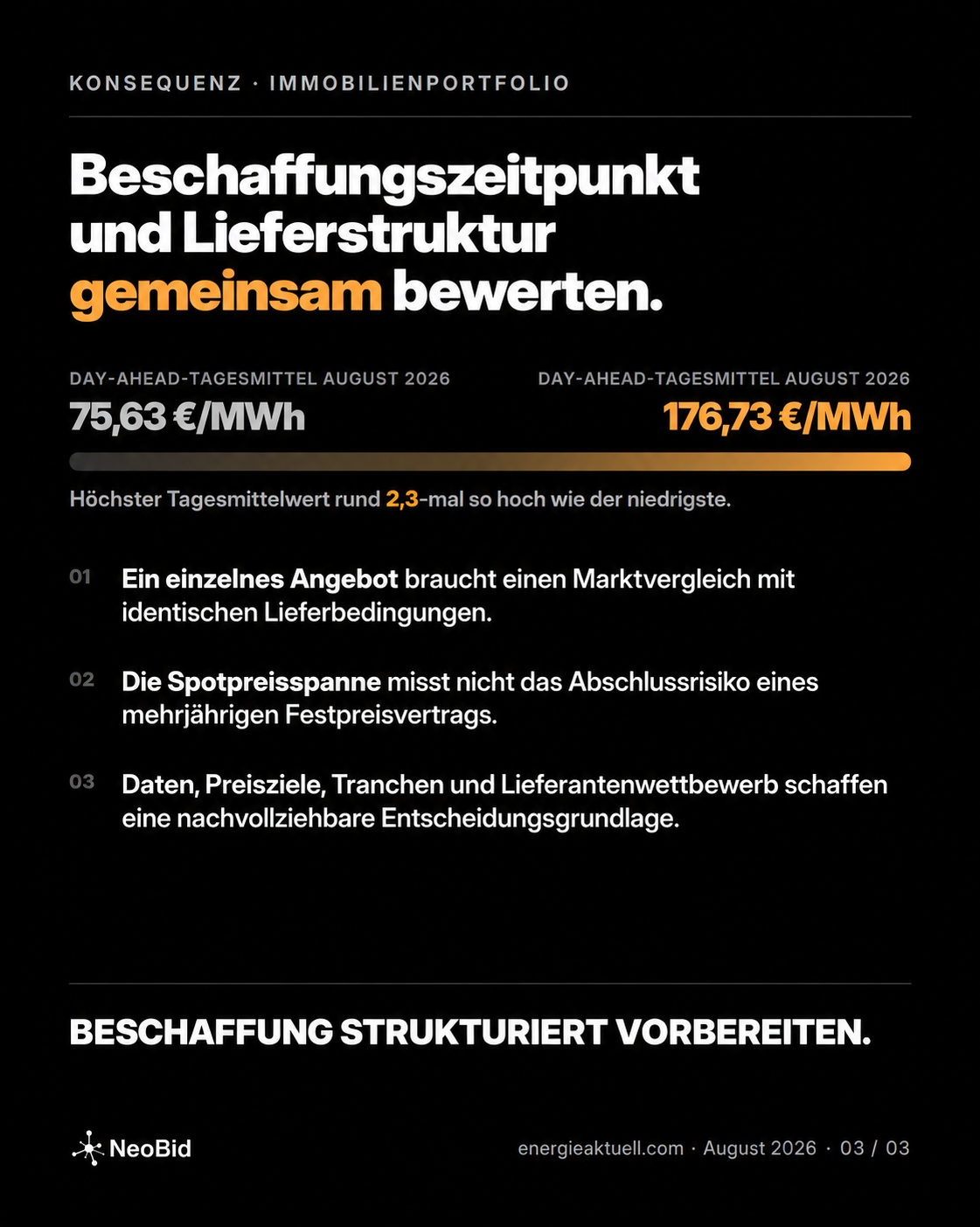
For August 2026, the data source used reports a range of €75.63 to €176.73/MWh for day-ahead daily baseload. The highest daily average was therefore about 2.3 times the lowest. This describes fluctuations in short-term delivery prices and does not measure the contracting risk of a multi-year fixed-price agreement. For multi-year supply contracts, the spot price alone is not decisive: the appropriate forward product, load profile, volume risks, supplier margins and contractual flexibility are particularly relevant.
What a structured procurement process should deliver
Consolidate contract end dates, notice periods and supply points early.
Review load curves and consumption volumes at portfolio and property level.
Set price targets, durations and fixed-price, indexed or tranche models before tendering.
Approach several suppliers with a consistent specification.
Compare offers using a reliable price comparison and defined decision criteria.
Document market developments and procurement decisions transparently.
Conclusion: structure beats intuition
The merit order explains why high renewable generation and rising forward prices can occur together. This does not imply a general purchasing recommendation for property portfolios. The key is to be ready to tender and decide before a market opportunity arises — with reliable data, a defined strategy and real supplier competition.
Data basis
Market figures refer to July and August 2026 and were reviewed again before publication. Sources: Next Kraftwerke — electricity market, July 2026, Energieaktuell — energy prices and Agora Energiewende — explanation of the merit order. Wholesale figures are not end-customer prices and do not replace an individual procurement recommendation.
Further reading: Energy market briefing — June 2026, Green energy: opportunities, limitations and options and Digitalisation and AI in energy procurement.
Review procurement strategy for your portfolio
Discuss with NeoBid how market data, consumption profiles and tender strategy should be brought together for your next procurement.