
“We are too small for a PPA.” This view often focuses on an individual building. Owners, asset managers and property managers should also consider the entire portfolio: aggregated demand can make long-term electricity offtake agreements accessible to smaller buyers.
What a PPA can provide for a property portfolio
A power purchase agreement (PPA) governs electricity offtake over an agreed period on defined terms. Under a green PPA, agreed generation often comes from a specific wind or solar plant. Property owners are particularly interested in longer-term price planning and documented renewable energy procurement.
Price protection applies to the contractually agreed volumes and price components. A PPA therefore does not automatically cover total consumption or all electricity costs. Residual electricity, deviations between generation and consumption, and other supply services must be included in the overall model.
Why company size alone is not decisive
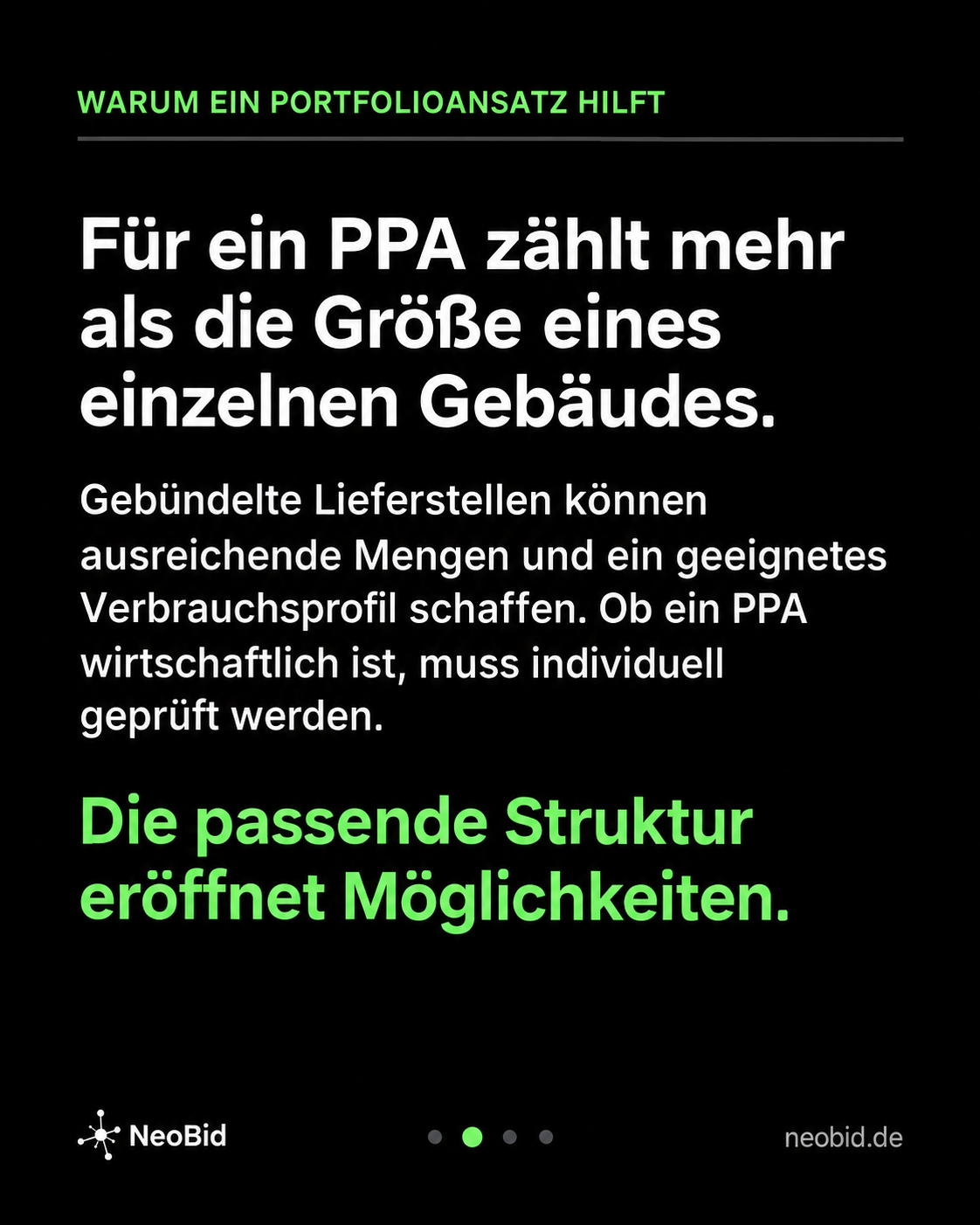
PPAs are often associated with the electricity demand of large industrial groups. An individual office building rarely reaches those volumes. However, aggregating several supply points can create a combined volume relevant to suppliers.
Smaller and medium-sized portfolios can therefore also be considered. Aggregation alone does not make them suitable for a PPA: consumption profile, contract duration, creditworthiness and organisational structure must fit the model offered.
Which requirements to assess before deciding
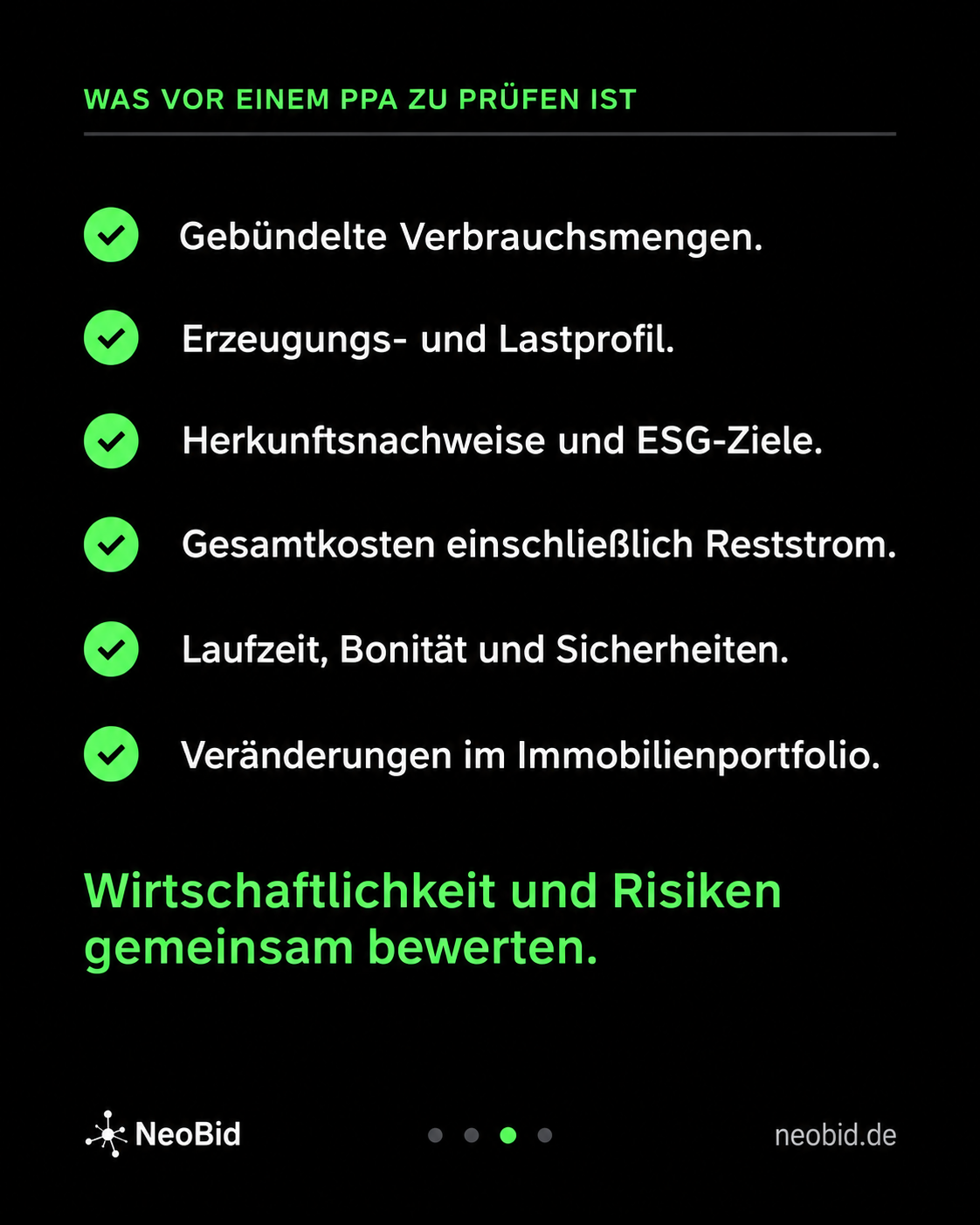
Available volumes: Which supply points can be procured together, and for how long will their consumption remain reliably available?
Generation and load profiles: How closely do electricity volumes match over time? Contractual provisions are needed for shortfalls and surpluses.
ESG objectives and evidence: What requirements do owners, investors and financing partners set for origin and documentation?
Total costs: Comparison with a fixed-price contract must also consider residual electricity, profile shaping, services and evidence. A PPA is not automatically cheaper.
Duration and risks: Multi-year commitments, credit requirements, collateral and possible changes in property holdings must be manageable.
Portfolio implementation: Contracting parties, responsibilities and integration of existing supply contracts must be clearly defined.
Green electricity needs evidence even under a PPA
A green PPA can make the link to a specific generation asset traceable. However, it does not replace the required evidence. Guarantees of origin and their proper cancellation are essential for electricity labelling. The German Environment Agency explains the role of guarantees of origin and the distinction between contractual allocation and physical electricity delivery.
A PPA therefore does not automatically meet all ESG requirements. Its significance for ratings, financing or property value depends on the relevant assessment criteria and its specific structure.
How NeoBid assesses PPA suitability
NeoBid uses consumption data to assess whether a PPA could fit the portfolio commercially and organisationally. Several supply points can be aggregated where appropriate. The model NeoBid IMMO-PPA combines long-term procurement with residual electricity supply matched to demand.
The decision should compare the entire model. A technical basis for assessing price and risk drivers is provided by the dena Green PPA pricing guide.
Conclusion: assess suitability before ruling it out
PPAs are not reserved for large corporations. Suitable aggregation can open access for smaller buyers too. What matters is whether volumes, profiles, costs and long-term commitments fit the property portfolio.
Would you like to assess whether a PPA is an option for your holdings? NeoBid supports the review of your data foundation and possible procurement models.