“Spot is always cheaper.” This comparison is too narrow for a property portfolio's electricity procurement. Low exchange prices in the past say little about which model will fit future consumption, budgets and risk tolerance.
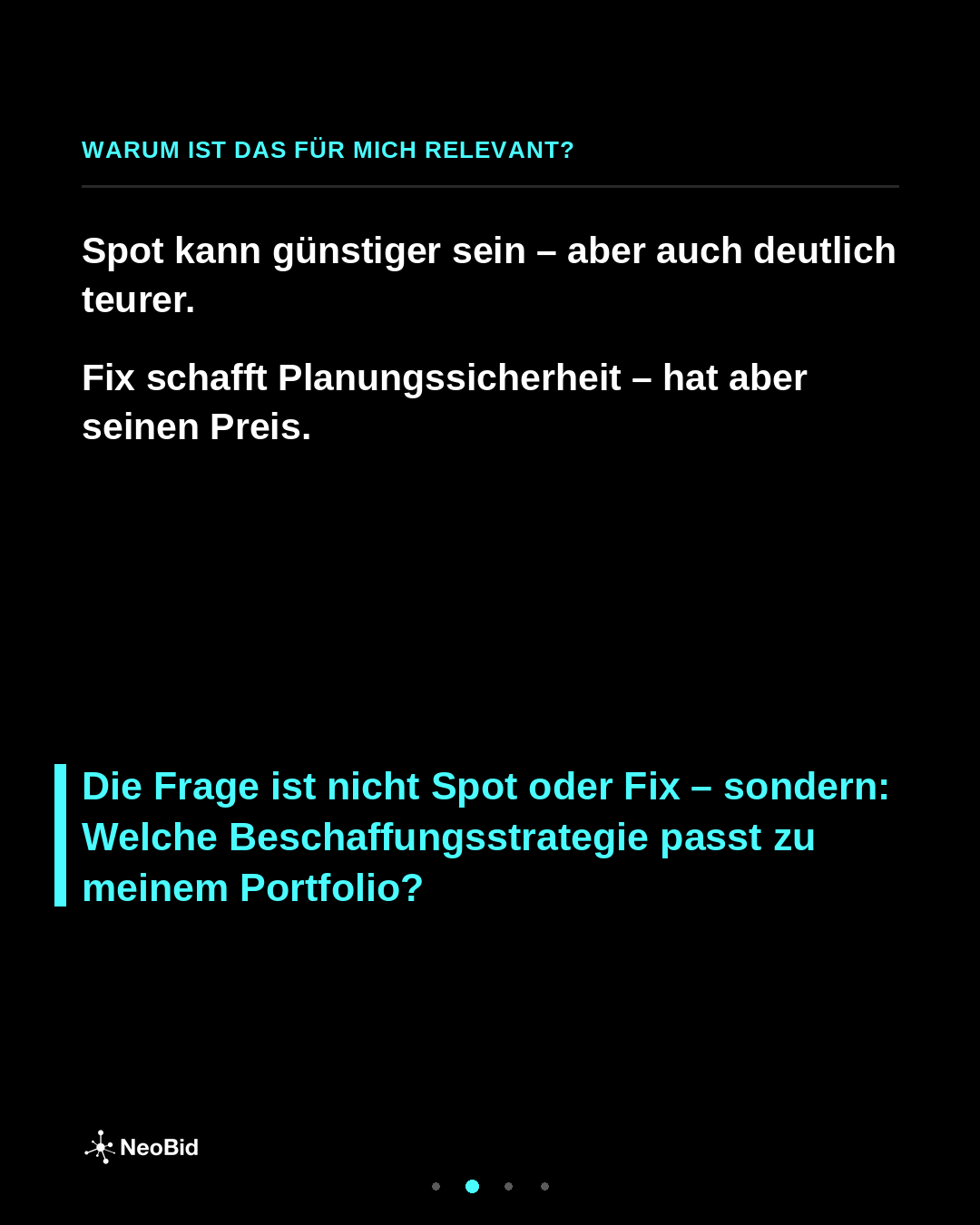
Spot and fixed prices allocate risks differently
Spot prices respond to short-term supply and demand. High wind and solar generation can favour low or negative exchange prices; limited generation with high demand can drive prices up. For 2025, the Federal Network Agency confirms several hundred hours of negative wholesale prices in Germany.
This is a historical market figure, not a forecast of future procurement costs. What matters is when the portfolio actually consumes electricity and how the supply contract passes through exchange prices. Network charges, levies and contractual mark-ups may still apply when exchange prices are negative.
A fixed price, by contrast, creates planning certainty for agreed price components and volumes. Hedging and the risks assumed are included in the supplier's calculation. The scope and exclusions of the price guarantee should therefore be assessed alongside the stated unit rate.
Why a favourable historical comparison is insufficient
The statement “spot is always cheaper” ignores budget risk. A low average exchange price need not match a property portfolio's consumption-weighted price. Nor does it establish which model will be cheaper in the next delivery year.
For owners, asset managers and property managers, price spikes can complicate operating cost and liquidity planning. Fixed service charge budgets, lease provisions and return targets help determine how much fluctuation is commercially manageable. This remains true even when a model appears inexpensive on an annual average.
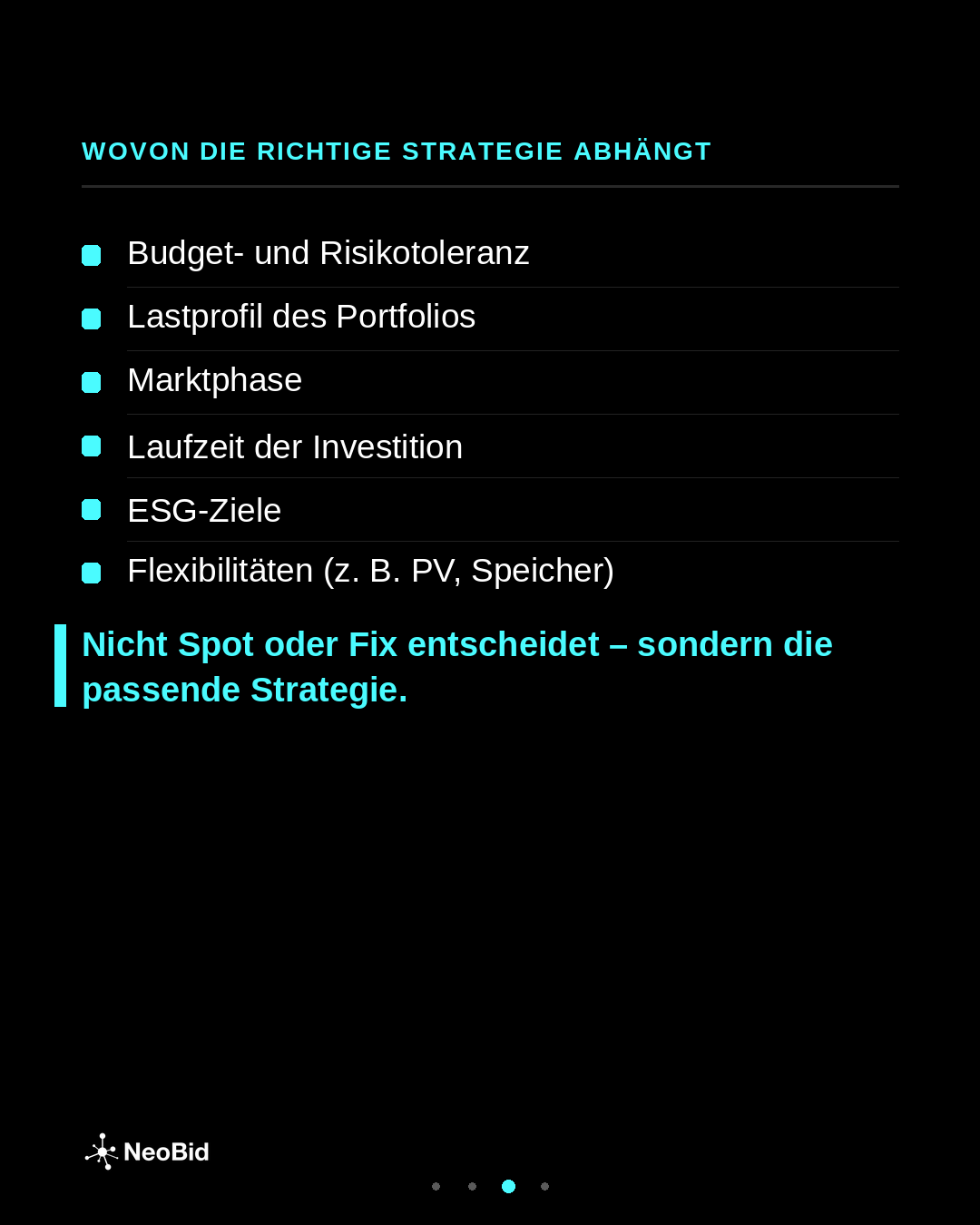
Six criteria for the procurement decision
Budget and risk tolerance: Which cost deviations and short-term spikes can the portfolio absorb?
Load profile: When is electricity needed, and how evenly is consumption distributed?
Market conditions: How should forward market offers be assessed against budget objectives and risks?
Holding period and contract duration: Do supply commitments fit planned disposals or changes of use?
ESG objectives: What requirements apply to green electricity, guarantees of origin or a possible PPA component?
Flexibility: Can photovoltaics, storage or controllable loads influence procurement and consumption?
Derive the procurement mix from the portfolio
Depending on the starting position, combining fixed and market-linked portions may be appropriate. The allocation requires clear budget objectives, risk limits and responsibilities. There is no universally applicable ratio.
NeoBid develops procurement strategy from consumption data, objectives and market conditions. Complete contractual terms and potential risks are compared. The article on energy procurement for property portfolios places this step in the overall process. For a long-term green electricity component, Myth #5 explains the requirements for a PPA.
Conclusion: assess costs and planning certainty together
Spot is neither always cheaper nor inherently unsuitable. A fixed price is not automatically better either. What matters is which procurement mix fits the holdings' consumption, budget and risk tolerance.
Would you like to assess spot and fixed-price shares for your portfolio? NeoBid helps compare models based on your consumption and contract data.