
German electricity and gas futures for delivery in 2027 rose sharply in October 2026 before falling back in early November. For property portfolios, the practical questions concern unhedged volumes, upcoming contract deadlines and exposure to winter demand. NeoBid’s market report compares prices on 30 October and 9 November and puts delivery years through 2030 into context.
The correction is not an all-clear
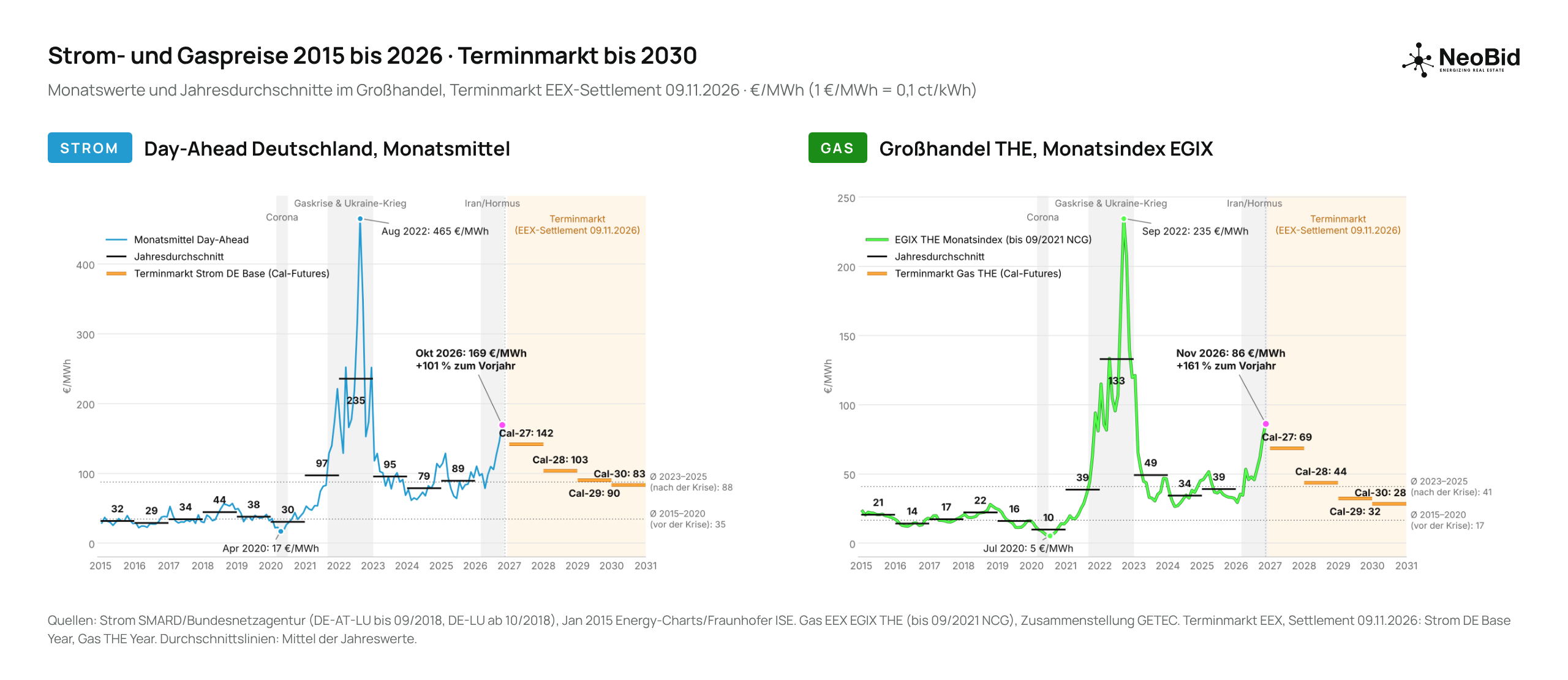
At the 30 October reference date, forward electricity for delivery in 2027 traded at €164.27/MWh and gas at €82.97/MWh. That represented a four-week increase of 25.5% for electricity and 36.9% for gas. Prices then eased in early November: on 9 November, electricity Cal-27 was €141.54/MWh and gas Cal-27 €68.52/MWh.
This reversal matters, but it is not a reliable outlook. Forward prices express the market's valuation of future delivery periods and their risks; they are not a forecast of a future customer invoice. Wholesale benchmarks are supplemented by, among other things, profile and procurement costs, network charges, levies, taxes and supplier margins.
The front year carries the largest risk premium
The curve shows a clear graduation: the nearer the delivery, the higher the risk valuation was in October. For electricity, Cal-27 was €164.27/MWh on 30 October, compared with €90.05/MWh for Cal-30. For gas, the respective values were €82.97/MWh for 2027 and €31.05/MWh for 2030.
That does not mean later delivery years can automatically be procured more cheaply. It does show why procurement should not be reduced to a single annual price. Delivery years, open volumes, budget limits and the risk of future price movements belong in the same decision.
Electricity: consider winter products and the consumption profile
In the electricity market, nearer products rose most sharply in October. The first quarter of 2027 stood at €220.59/MWh on the reference date, well above the annual contract. Gas prices, carbon costs and weather-dependent generation shape short-term price formation in many hours.
For property businesses, the actual load profile therefore matters alongside the procurement strategy. A portfolio with high winter demand or many heating- and operations-intensive uses reacts differently from one whose consumption is more evenly spread. The right procurement strategy connects this consumption perspective with delivery periods and contract structure.
Gas: lower storage reserves increase sensitivity
German gas storage facilities were 61.2% full on 30 October, 13.8 percentage points below the previous year. A smaller buffer increases sensitivity to cold weather, high withdrawals or disruption to supply routes. It does not establish an acute shortage: the German Federal Network Agency assessed gas supply as stable.
The price movement was likewise concentrated in 2027 and the winter quarter. Procurement should therefore focus not only on general market commentary, but on the practical question: which gas volume remains open for which delivery period? Structured contract support makes terms, renewal options and forthcoming decisions visible.
Four questions for the next procurement decision
First: which electricity and gas volumes are already price-fixed for each delivery year, and which remain open? Second: when do contracts end, and what volume risks arise from vacancy, new lettings or changed operating hours? Third: which price level is affordable within the budget? Fourth: which decision rule applies when the market moves sharply again?
The market movement does not imply either fixing everything immediately or waiting as a matter of principle. It is a reason to review the procurement position, risk limits and data basis together. Reliable consumption and contract data can be prepared for ongoing portfolio work through energy data and reporting.
Request the October market report
Email us and we’ll send you the full NeoBid October 2026 market report. We can also brief your team on the electricity and gas markets and explain what recent developments mean for procurement, budgets and risk across your property portfolio.