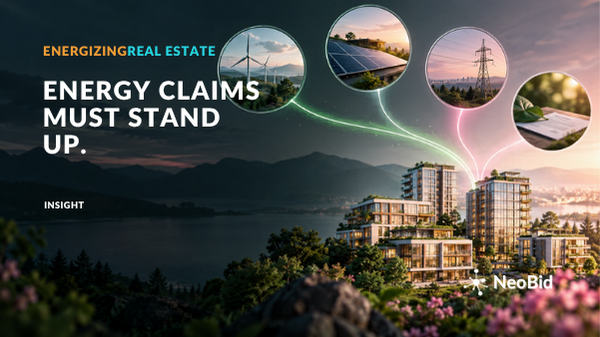
Sustainability communication does not begin with a label. When discussing green electricity, carbon reduction or energy savings, the claim should be clearly scoped and supported by an understandable basis. For property portfolios, consumption, supply point, contract content, period and evidence need to align.
Why energy claims require more precision
A stricter framework against misleading sustainability claims has applied since 27 September 2026. The new rules principally address communication with consumers. While energy procurement for a property portfolio is often B2B, public communications, tenant information and sales-facing statements can still be directly relevant.
The question is therefore not only whether a claim is well intentioned. It is also: Which buildings, energy volumes and time period does it cover – and how can it be demonstrated? The legal framework is set out in EU Directive 2024/825 and the German Act against Unfair Competition.
It is the evidence, not the word “green”, that matters
“Green electricity”, “climate-neutral operations” and “CO₂-reduced” are not interchangeable claims. An electricity supply may, for example, be supported by a product with guarantees of origin. That does not automatically justify a statement about the entire building operation, every energy carrier or the whole value chain.
Communication becomes more robust when it remains specific: What exactly was procured or changed? Which supply points does the statement cover? Which period is meant? And what documentation exists? This clarity prevents misunderstandings and improves internal decision-making.
Four questions before making an energy claim
First: Is the subject clearly defined? A statement about individual supply points or a contracted volume should not silently be extended to the whole portfolio. Second: Is the period stated? Procurement, consumption and reporting years may differ.
Third: Is there verifiable evidence? This may include contract documents, guarantees of origin, metering data, invoices or a documented calculation approach. Fourth: Is the wording proportionate? A partial measure does not automatically demonstrate an overall environmental impact. Missing data, estimates and exclusions should remain visible.
Consider data and contracts together
In practice, information is often spread across systems: contract data with procurement, consumption values with metering providers and reporting needs in asset or property management. A robust claim emerges only when these perspectives are brought together and the coverage is made transparent.
Energy data and interfaces provide a working basis. For claims about energy procurement, it is also important to understand the terms, volumes and products in the relevant contracts. This makes clear what has actually been agreed – and what a statement does not cover.
How NeoBid can help
NeoBid helps structure energy information for property portfolios: assessing supply points and contracts, documenting procurement decisions and making available consumption data useful for ongoing work. This does not replace a legal review of an individual marketing claim.
It does, however, create a better basis so that sustainability communications are not detached from operational reality. An appropriate procurement strategy and a clear data pathway help keep claims consistent, understandable and verifiable.
Discuss energy data and procurement
Would you like to assess which data, contract information and evidence are already available for your portfolio? We can review the starting point and practical next steps together.