ENERGY GLOSSARY / ALL TERMS ↗
Data and metering
What does load profile mean?
A load profile describes how energy demand is distributed over time. A measured load curve contains values at successive time intervals. A standard load profile instead models typical patterns. Annual consumption combines demand into a single quantity.
For a property portfolio, timing matters alongside volume: when do ventilation and cooling run? How does occupancy change? When is on-site solar electricity available?
CALCULATION EXAMPLE · NOT MARKET PRICES
Same volume. Different weighting.
Period A · 10 ct/kWhPeriod B · 20 ct/kWh
12 ct/kWh Weighted energy price
€120 Energy component for 1,000 kWh
NeoBid’s own simplified calculation using illustrative values. Total volume: 1,000 kWh. Energy component only; other price components are excluded.
A LOOK INSIDE THE ENERGY PLATFORM
See the load curve across the year.
A load curve shows how power demand develops over time. This platform view summarises a year’s values as daily peaks and daily averages, revealing seasonal differences and demand peaks.
 Energy Platform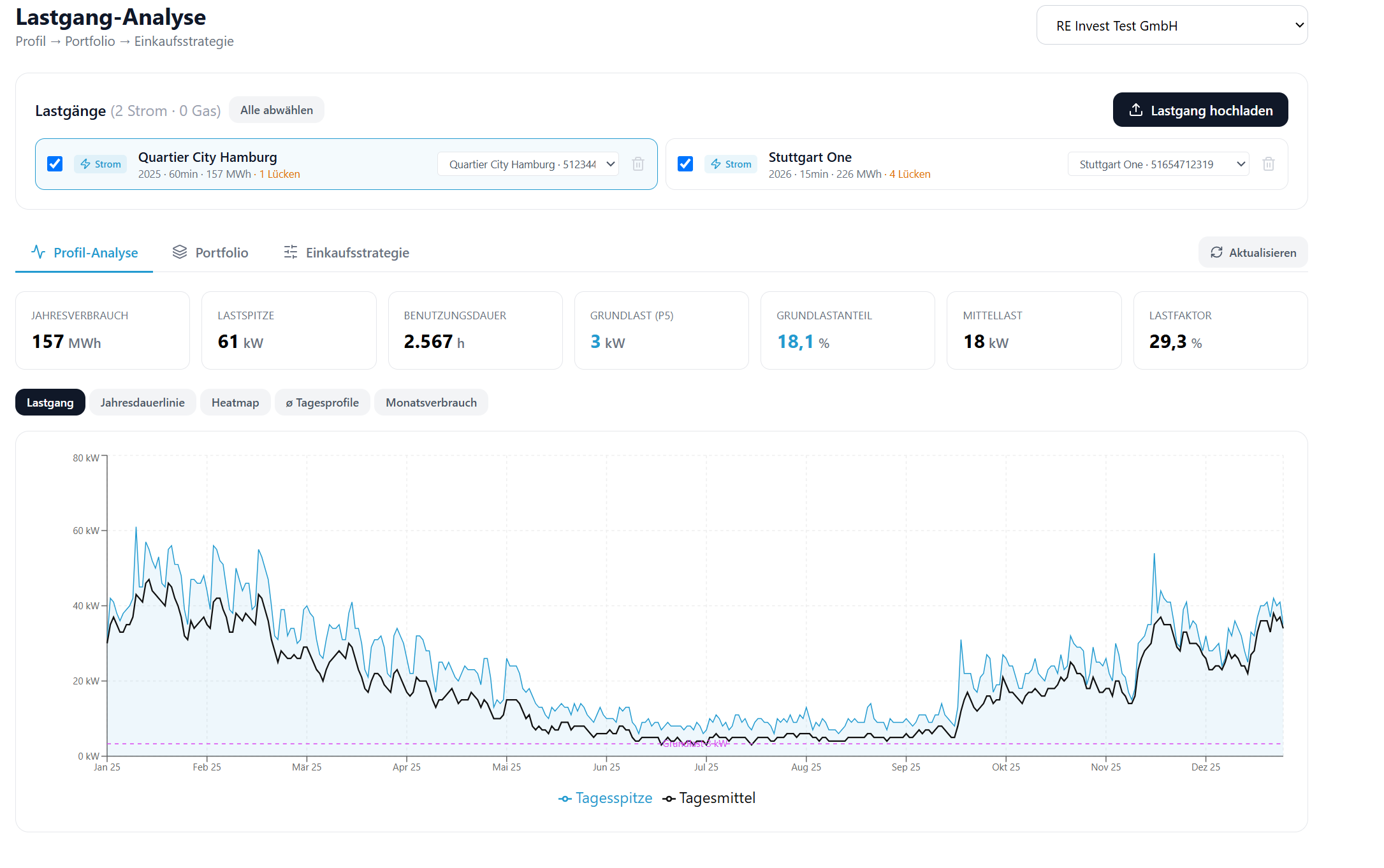
PROPERTY PRACTICE
Understand demand over time.
Assess supply points individually before combining volumes. An office, hotel and logistics site may have different daily and weekly patterns. Historical data provide a starting point; planned changes of use also belong in procurement planning.
An example.
Two illustrative periods, two energy prices: 10 and 20 ct/kWh. Consuming 800 kWh in the cheaper period and 200 kWh in the more expensive period costs €120, or 12 ct/kWh. Reversing the distribution costs €180, or 18 ct/kWh, for the same 1,000 kWh.
The example shows only volume weighting of the energy price. It uses no market prices and excludes network charges, taxes and other supply components. An actual offer also depends on the chosen contractual model.
WHAT MATTERS
Three questions for your portfolio.
Do historical values still reflect the building’s future use?
Does demand planning account for vacancy, new equipment and on-site generation?
Make the distinction clear
Annual consumption is not a load curve. Nor is a standard load profile a measurement of an individual building. The BDEW guide explains the update to standard electricity profiles; this article deliberately does not assume universal metering thresholds.
Sources reviewed: 18 September 2026 · Editorial team: NeoBid
BDEW · Updated standard electricity load profiles, 2025Examples and diagrams are schematic. Their application depends on your data and contract terms.
Look up another term.
35 terms
Markets and prices
Baseload
In electricity trading, baseload describes a standardised profile with constant power throughout the defined product period.
Understand the term Markets and pricesCapacity charge
A capacity charge prices the power demand relevant for billing, often in euros per kilowatt per year.
Understand the term Property practiceCommunal electricity
Communal electricity is a common term for electricity used by shared areas and systems within a building.
Understand the term Data and meteringEnergy supplier
The energy supplier sells and supplies energy under a supply contract.
Understand the term ProcurementFixed price
A fixed price establishes a defined price for an agreed period.
Understand the term Markets and pricesForward market and forward price curve
Products for future periods are traded on the forward market.
Understand the term ProcurementFull supply
Full supply is a model in which the supplier covers agreed energy demand and takes on key procurement and settlement tasks.
Understand the term Data and meteringGas conversion factor
The gas conversion factor is a dimensionless factor used to convert measured gas volume from operating conditions to the specified standard conditions.
Understand the term SustainabilityGreen electricity and additionality
Green electricity describes electricity products with agreed renewable origin characteristics.
Understand the term Data and meteringGross calorific value
Gross calorific value describes a fuel’s energy content under defined conditions and includes heat recoverable when water vapour condenses.
Understand the term Green electricity and evidenceGuarantee of origin
A guarantee of origin documents the renewable origin of a quantity of electricity.
Understand the term Data and meteringkW, kWh and MWh
The kilowatt (kW) is a unit of power.
Understand the term Data and meteringLoad profile
A load profile describes how energy demand is distributed over time.
Understand the term Data and meteringMarket location
A market location is a place in the energy market where energy is generated or consumed.
Understand the term Markets and pricesMerit order
The merit order describes a supply ranking ordered by costs or bid prices.
Understand the term Data and meteringMeter number
The meter number identifies a specific metering device.
Understand the term Data and meteringMetering location
A metering location is the place where energy is measured.
Understand the term Data and meteringMetering operator
The metering operator is responsible for operating the metering point.
Understand the term Markets and pricesNetwork charges
Network charges pay for use of the electricity or gas network.
Understand the term Data and meteringNetwork operator
The network operator operates the local energy network and enables energy transmission or distribution within its area of responsibility.
Understand the term Markets and pricesPeakload
Peakload describes a standardised electricity trading profile covering a defined subset of hours within a product period.
Understand the term ProcurementPower purchase agreement (PPA)
A power purchase agreement is an individually negotiated electricity offtake contract.
Understand the term ProcurementPrice guarantee
A price guarantee is a contractual commitment to keep specified price components stable for a defined period.
Understand the term Property practiceProperty changes and vacancy
Property changes or vacancy may alter a supply point’s use, contracting party and consumption.
Understand the term ProcurementResidual electricity demand
Residual electricity demand is the electricity requirement that must be covered in addition to defined self-supply or allocated deliveries.
Understand the term Data and meteringRLM – interval demand metering
RLM refers to recording power demand at successive time intervals.
Understand the term Data and meteringSLP – standard load profile
A standard load profile is a typical consumption pattern over time.
Understand the term ProcurementSpot market and indexed procurement
Energy is traded at short notice on the spot market.
Understand the term Markets and pricesStanding charge
The standing charge is a fixed, time-based tariff component, such as an amount per month or year.
Understand the term Property practiceSupplier switching and notice periods
Switching supplier replaces the energy provider at a supply point.
Understand the term ProcurementSupply point aggregation
Aggregation combines several supply points in a single procurement process.
Understand the term Property practiceTenant electricity
Tenant electricity describes a supply model for building occupiers, often incorporating locally generated solar electricity.
Understand the term ProcurementTranche procurement
Tranche procurement spreads price fixing for the expected demand across partial volumes and several purchasing dates.
Understand the term Markets and pricesUnit rate
The unit rate is a price related to the amount of energy consumed, for example in cents per kilowatt-hour.
Understand the term ProcurementVolume tolerance and excess or shortfall
A volume tolerance defines a contractually agreed range around a reference volume.
Understand the termNo matching term found. Try another spelling or reset your selection.
Take your knowledge further.
YOUR NEXT STEP
Let’s start
a conversation.
In our first meeting, we discuss your portfolio, upcoming contract deadlines and objectives. Together, we identify useful documents and next steps. You do not need a complete dataset to get started.
Arrange an introductory meeting ↗